Showing posts with label Pista ng Pelikulang Pilipino 2017. Show all posts

Monday, August 28, 2017

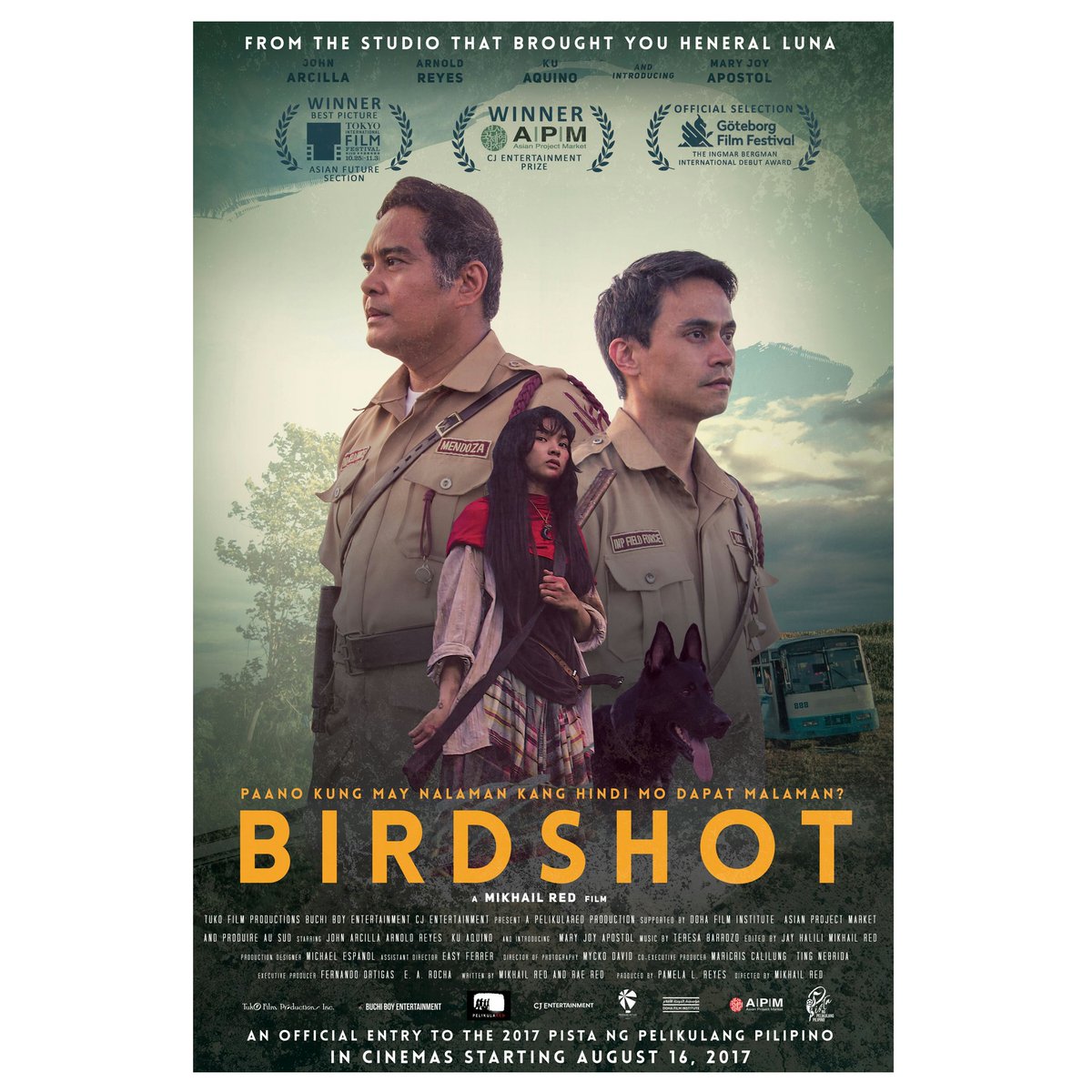
Birdshot (Mikhail Red, Pista ng Pelikulang Pilipino 2017)


Image result for birdshot poster

I missed out on this film during the opening night of Cinemalaya 2017. I wasn't worried though about not having a chance to see the film. With the production group TBA supporting the film, it was bound to have multiple screenings in different venues.

I caught up with Birdshot on a rainy evening, a day after the nation breezed through with Ninoy Aquino Day. Putting it simply, Birdshot is one of the best films of 2017. 

Birdshot is a mature, majestic exploration of violence and police corruption in the Philippines. From the onset, Birdshot seems to be set in Marcos Martial Law era. The police wear khaki uniforms similar to constabulary uniforms. The telephone being used has a rotating dial. However, in a police precinct, a poster of the Philippine National Police (PNP) is prominently captured in a shot suggesting that the film is not set in a certain era. PNP was founded in 1991 as a result of the merger of Philippine Constabulary and the Integrated National Police.

The bloody incidents in the movie refer to events after the 1986 Edsa People Power Revolution. Maya's fatal shooting of a haribon was based on the killing of a Philippine eagle by a farmer in 2008.

The gist of the movie focuses on a more gruesome crime. Police are investigating the disappearance of a busload of passengers. This mysterious incident refers to three events that bloodstained the reign of the Aquinos and Gloria Macapagal-Arroyo. 

In January 1987, barely a year after the ascension of Cory Aquino to the presidency, legions of farmers asking for government action on land reform trooped to Mendiola. They were met with a hail of bullets from the police. At least 13 protesters died in the aftermath of the violent dispersal. While other rich families lost their lands to agrarian reform, the Aquinos are able to maintain control of Hacienda Luisita because of the Stock Distribution Option scheme.

In August 2010, barely two months after Benigno Aquino III assumed into office, a busload of tourists was commandeered by a dismissed policeman. The latter shot to death 8 passengers, all of them Chinese tourists. In the movie, an Eduardo Aquino was connected with the hijacked bus.

The third event is the Maguindanao massacre of 2009. A convoy of vehicles were ordered to stop at a checkpoint manned by armed renegades in Maguindanao. 57 passengers, including 25 media people, were then killed and haphazardly buried along with the vehicles.

In Birdshot, the highly memorable, final shot of the burial place inside the Davao eagle sanctuary recalls horrific incidents in the Philippines. Prominent among the bodies is that of a half-buried corpse with a hand held up as if surrendering or meekly pleading for mercy. As I'm writing this, I imagine it to be extra-judicial killing victim Kian delos Santos begging the police to have mercy. 

Tama na po. May test pa po ako bukas!

The haphazard burial of the bodies recalls the Manila Film Center accident in 1981. Scores of workers were buried in an avalanche of quick-drying cement. There were stories of breathing workers buried alive because the Center was being rushed for the opening night of the Manila International Film Festival. A worker or two might have raised their hands trying to wave off the incoming rush of cold cement.

To the millenials, the final shot vividly recalls the Maguindanao massacre. 

More importantly, the final shot also recalls extra-judicial killings in Davao. In 2009, Commission on Human Rights Chairperson Leila de Lima, investigating the so-called Davao Death Squad, dug up human bones from a 'mass grave' in Davao City. 

The perpetrators of these incidents tried to cover up their crimes in different ways. Bodies were buried in cement or mass graves. Maya's father buried the shotgun in their yard. On the other hand, big shots bully their critics or subordinates into submission. Policeman Domingo (Arnold Reyes) transmogrified into a brutal police monster after receiving overt threats.

Birdshot reminds people that covering up a crime will do them no good. Ultimately someone, a courageous media reporter, a dedicated police investigator, or a persistent human rights activist, will unearth the truth and expose their shortcomings. Maya's father Diego underwent torture and died.

Birdshot suggests that police corruption and brutality did not end with the lifting of Marcos Martial law. Abuses by PNP personnel exist until today. Human rights activists should not turn a blind eye on these abuses.

Courageous human rights activists are a rare species like the Philippine eagle. With their sharp eyes, they keenly monitor the happenings around the country. They remain focused and determined in pointing out abuses of the police and the military. They should not be mindlessly shot down or threaten with death. They should be protected.


Saturday, August 19, 2017

100 Tula Para Kay Stella (Jason Paul Laxamana, Pista ng Pelikulang Pilipino 2017)


POEM # 143
Diretso, kaliwa o kanan
Ano'ng tatahaking lansangan?
Tanong ng bida sa kawalan
O Fidel Lansangan
Right path na ba yan?


     POEM # 333
Stella Puno ang ngalan
Punung-puno ng paandar
Gustong maging star
Nabingwit ni photocopier man


POEM # 1505
Pelikulang tumatabo sa takilya
Ikinatuwa ni Bela
Nawa'y ibang pelikula
Okay din sana 
Yehey! Isisigaw nila


POEM # 2017
Paalala ni Rio Alma
Tangkilikin at ibunyi ng taas noo
Pista ng Pelikulang Filipino
Opo. Filipino po ang tama


POEM # 1024
Mga tulang sinulat
Alay sa rakista
Ready na akong magtapat
Aray! May iba na siyang sinta!


Photo courtesy of 100 Tula Para Kay Stella FB page

Monday, October 24, 2016

Patay na si Hesus (Victor Villanueva, QCinema 2016)


The rise in number of regional filmmakers has done wonders to the diversification of ideas and genres in the indie film scene. However, grant-giving bodies have mostly supported drama films. Cinemalaya’s slate for this year shows a pair of full-length film comedies. Cinema One Originals have consistently supported horror/science fiction/fantasy filmmakers but majority of the film finalists is still of the dramatic or romantic mold. Metro Manila Film Festival offers the widest selection of film genres. But, the quality of the films leaves much to be desired.

The deliciously hilarious Patay na si Hesus is a rare find.  It is a Cebuano film with tongue firmly on cheek. The icing on the cake is that it even passed the Bechtel test. I was flummoxed with this part of the citation handed out to the film. An online search on Bechtel test says that in order for a film to be a passer it must hurdle three components:  1) there must be two named female characters, 2) who talked with one another, 3) on any issue except men.

Male characters involved with females in the film are basically losers. That must be the main reason why they don’t get to be main topics of discussions. They are worthless nincompoops. The recently departed Hesus left his family for a woman. He eventually left her for another woman. Jay, second son of Hesus, refuses to attend his father's wake but eventually relents due to maternal pressure. The son, though, is also a loser.  He flunked the Engineering board exams twice and was found out to have called off his third board exam attempt.

On the other hand, the major female characters are strong, resilient, and a bit crazy.

A middle-aged mother, Iyay (Jaclyn Jose), hauls her Cebu-based family onto a multicab for an inter-island trip back to their ancestral house in Dumaguete City. Years of estrangement from her husband Hesus had deadened her emotions. Even her children are reluctant to see their late father. But, the tears eventually broke through for the dead. Tough luck for Hesus, the tears shed are not for him but for their dog named Hudas.

The dysfunctional family picked up the sister of Hesus on their way to Negros. The nun (Angelina Kanapi) provided some of the more outrageous laugh-out-loud scenes. A bad case of flatulence served as catalyst for her to throw caution to the wind. She sheds off her religious life and hitches a motorcycle ride to freedom. I also loved the hysterically funny scene wherein she showed her grief over the loss of her niece.

The very-much alive niece, Judith, is a tomboy. She copes with a domestic break-up by drinking alcohol with a group of men. The best visual gag of the film shows her raising her left arm exposing an exaggeratedly hairy armpit.

If there’s a comedy film that comes closest to the gross-out jokes and visual gags of Patay na si Hesus, it is the American film There’s Something About Mary. The sperm jokes are sick but outright comical. The dead dog jokes are wickedly humorous, too.

The laugh-a-thon film Patay na si Hesus won the Audience Choice Award and the Gender Sensitivity Award at the QCinema International Film Festival 2016.


Sunday, July 31, 2016

Pauwi Na (Paolo Villaluna & Ellen Ramos, ToFarm Film Festival 2016)


ToFarm Film Festival produced a decent crop of exceptional films such as Pauwi Na and Paglipay. The organizers treated the film makers well and they reaped some good karma in return.

Pauwi Na is a surprise film entry. It barely touched on the festival theme of farmers and farming. The gist of the story is about a family of five going back to their province. It may be that the screening committee sees their story as a sentimental 'back to one's roots' tale.

The family's journey is quite a challenge because they have to ride a pedicab. The sickly father (Bembol Roco) is quite accustomed to driving a pedicab but he is no longer young. Fed up with a non-paying client and stressed by urban living, he decides to take his family back home. His main reason, though, is he wants to be buried in his hometown. That story plot is taking the 'back to roots' imagery too far.

The tragic story seldom strays into melodrama because of suave cinematic inputs of the filmmakers. The pregnant daughter-in-law Isabel (Meryll Soriano) is blind but can see and chat with Jesus Christ. She gets wisdom and sometimes crucial help from the Lord.

A hysterically funny scene shows the visually impaired Isabel crossing a busy highway. The audience knows she has a guide but her family doesn't know a thing. A shot of a huffing pregnant woman in the middle of the street is juxtaposed with a shot of anxious, deeply worried family members. This whole segment is a brilliant piece of editing.

The use of black and white sequences to portray fantasy scenes also help the film from being overly dramatic. There are two deaths in the family. One such death scene was prefigured through the use of a black and white sequence.


The final shot of the remaining family members with their 'angels' backdropped with a scenic rustic view suggests that paradise is not a province. Paradise is a place where your family is. It may be a verdant field or it may be a shanty house or it may be a pedicab. As long as two family members or more decide to stick with one another, paradise will always be in their midst. Ask Isabel, she knows.