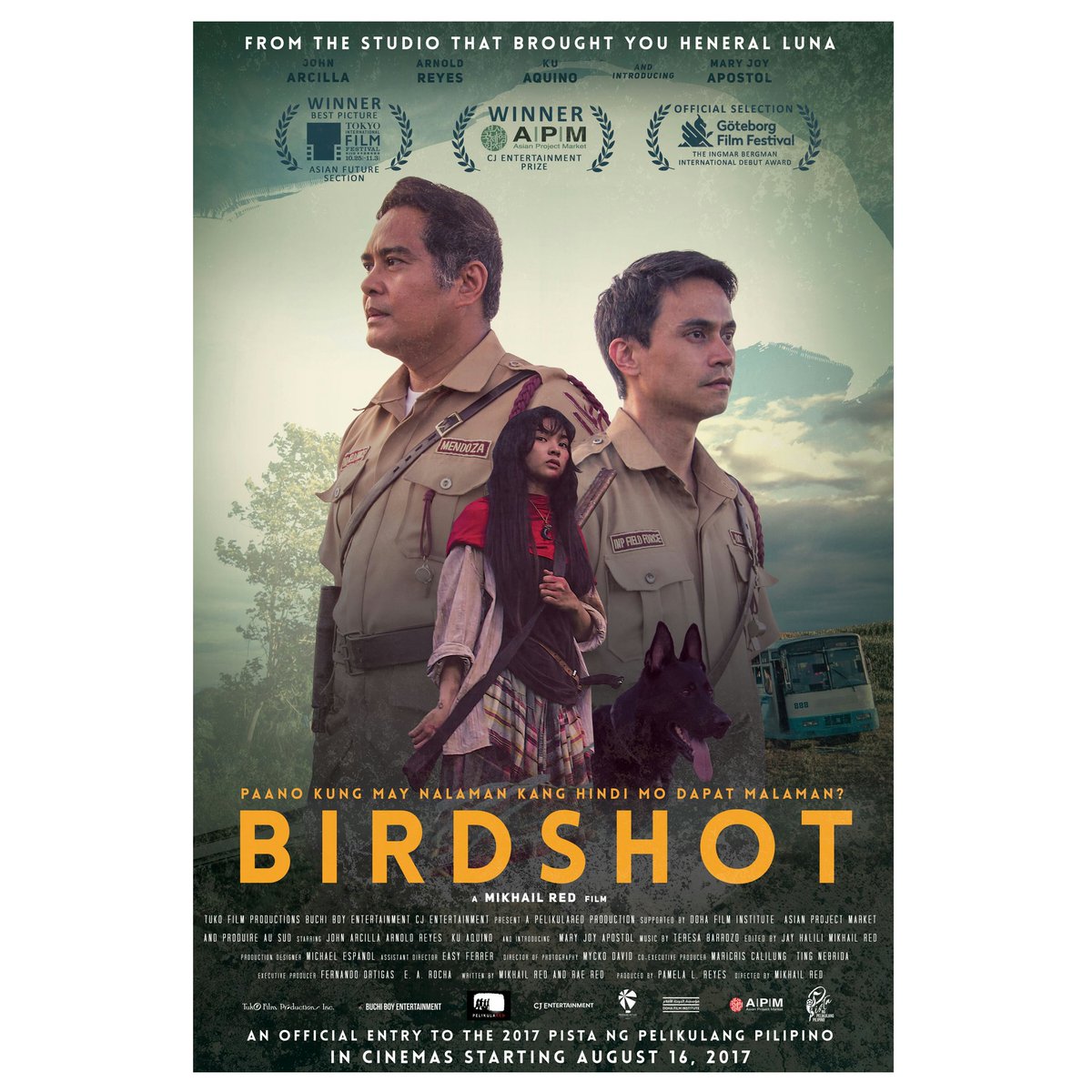
I missed out on this film during the opening night of Cinemalaya 2017. I wasn't worried though about not having a chance to see the film. With the production group TBA supporting the film, it was bound to have multiple screenings in different venues.
I caught up with Birdshot on a rainy evening, a day after the nation breezed through with Ninoy Aquino Day. Putting it simply, Birdshot is one of the best films of 2017.
Birdshot is a mature, majestic exploration of violence and police corruption in the Philippines. From the onset, Birdshot seems to be set in Marcos Martial Law era. The police wear khaki uniforms similar to constabulary uniforms. The telephone being used has a rotating dial. However, in a police precinct, a poster of the Philippine National Police (PNP) is prominently captured in a shot suggesting that the film is not set in a certain era. PNP was founded in 1991 as a result of the merger of Philippine Constabulary and the Integrated National Police.
The bloody incidents in the movie refer to events after the 1986 Edsa People Power Revolution. Maya's fatal shooting of a haribon was based on the killing of a Philippine eagle by a farmer in 2008.
The gist of the movie focuses on a more gruesome crime. Police are investigating the disappearance of a busload of passengers. This mysterious incident refers to three events that bloodstained the reign of the Aquinos and Gloria Macapagal-Arroyo.
In January 1987, barely a year after the ascension of Cory Aquino to the presidency, legions of farmers asking for government action on land reform trooped to Mendiola. They were met with a hail of bullets from the police. At least 13 protesters died in the aftermath of the violent dispersal. While other rich families lost their lands to agrarian reform, the Aquinos are able to maintain control of Hacienda Luisita because of the Stock Distribution Option scheme.
In August 2010, barely two months after Benigno Aquino III assumed into office, a busload of tourists was commandeered by a dismissed policeman. The latter shot to death 8 passengers, all of them Chinese tourists. In the movie, an Eduardo Aquino was connected with the hijacked bus.
The third event is the Maguindanao massacre of 2009. A convoy of vehicles were ordered to stop at a checkpoint manned by armed renegades in Maguindanao. 57 passengers, including 25 media people, were then killed and haphazardly buried along with the vehicles.
In Birdshot, the highly memorable, final shot of the burial place inside the Davao eagle sanctuary recalls horrific incidents in the Philippines. Prominent among the bodies is that of a half-buried corpse with a hand held up as if surrendering or meekly pleading for mercy. As I'm writing this, I imagine it to be extra-judicial killing victim Kian delos Santos begging the police to have mercy.
Tama na po. May test pa po ako bukas!
The haphazard burial of the bodies recalls the Manila Film Center accident in 1981. Scores of workers were buried in an avalanche of quick-drying cement. There were stories of breathing workers buried alive because the Center was being rushed for the opening night of the Manila International Film Festival. A worker or two might have raised their hands trying to wave off the incoming rush of cold cement.
To the millenials, the final shot vividly recalls the Maguindanao massacre.
More importantly, the final shot also recalls extra-judicial killings in Davao. In 2009, Commission on Human Rights Chairperson Leila de Lima, investigating the so-called Davao Death Squad, dug up human bones from a 'mass grave' in Davao City.
The perpetrators of these incidents tried to cover up their crimes in different ways. Bodies were buried in cement or mass graves. Maya's father buried the shotgun in their yard. On the other hand, big shots bully their critics or subordinates into submission. Policeman Domingo (Arnold Reyes) transmogrified into a brutal police monster after receiving overt threats.
Birdshot reminds people that covering up a crime will do them no good. Ultimately someone, a courageous media reporter, a dedicated police investigator, or a persistent human rights activist, will unearth the truth and expose their shortcomings. Maya's father Diego underwent torture and died.
Birdshot suggests that police corruption and brutality did not end with the lifting of Marcos Martial law. Abuses by PNP personnel exist until today. Human rights activists should not turn a blind eye on these abuses.
Courageous human rights activists are a rare species like the Philippine eagle. With their sharp eyes, they keenly monitor the happenings around the country. They remain focused and determined in pointing out abuses of the police and the military. They should not be mindlessly shot down or threaten with death. They should be protected.


